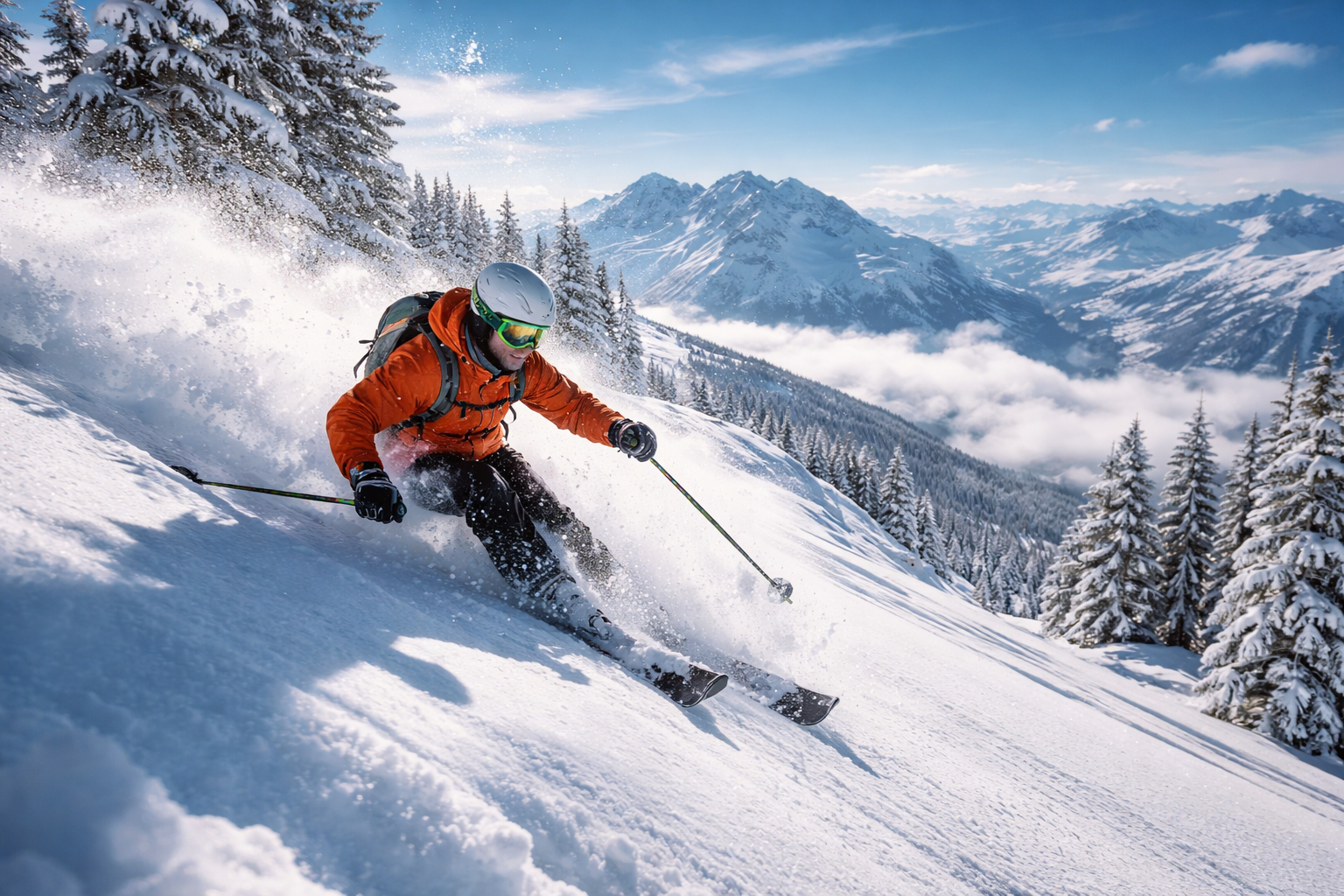
Adaptive Ski Coach:
Every Run Is a Lesson.
A premium ski equipment brand had the sensors and the build quality, but no intelligence layer. We built an agent into the gear that turns every run into a coaching session — analyzing technique from motion data, assessing skill level continuously, and evolving its guidance as the skier improves. Not a dashboard. A coach that knows when to push and when to let you ski.
Multi-sensor motion fusion · Real-time technique analysis · Continuous skill level assessment · Adaptive coaching engine · Feedback budget system · Run-by-run progress tracking · Plateau detection & strategy switching
A skier on their second day on the mountain needs completely different guidance from someone chasing advanced technique. The agent had to assess where each user actually was, and meet them there.
Coaching, not reporting.
Most smart sports gear drowns users in metrics. Graphs of edge angles and turn radii mean nothing to a skier mid-session. We started from a different premise: the agent's job is to make you better, not to show you data. One actionable insight per run beats a hundred statistics.
Generic advice doesn't work at scale
A second-day beginner and an advanced carver need completely different guidance. The system can't deliver one-size-fits-all tips — it has to assess where each user actually is, identify the specific mechanical gap holding them back, and coach from that point.
Too much feedback is worse than none
Early prototypes overwhelmed beginners with five corrections per run. They disengaged. The agent needed a feedback budget — a hard limit on how many things to say, and a system for choosing which one matters most right now.
Sensors see motion, not meaning
Raw IMU values — accelerations, rotations, timestamps — mean nothing to a language model and nothing to a skier. The gap between sensor data and coaching insight requires a translation layer that converts physics into biomechanical language.
Four capabilities that turned gear into a coach.
Motion Sensor Fusion & Technique Analysis
IMUs in boots and poles capture full-body movement across every run. The agent builds a real-time model of weight distribution, edge angle, turn timing, and pole plant positioning — the mechanics that actually determine how well someone skis. A preprocessing layer converts raw sensor readings into structured natural-language motion descriptions before the LLM ever sees them.
Continuous Skill Level Assessment
Using a progressive assessment model, the agent evaluates current skill level and identifies the specific mechanical gaps that separate each user from the next stage. Assessment updates dynamically with every run — as you improve, the baseline shifts. Five levels tracked continuously, with transition criteria derived from biomechanical benchmarks.
Adaptive Coaching Guidance
Coaching is calibrated to the skier's level, learning pace, and terrain type. Beginners get fundamentals. Intermediate skiers get targeted technical refinements. Advanced users receive performance optimization. The system prompt defines a coaching philosophy: one or two corrections per run, always framed as what to do — never what was wrong.
Run-by-Run Progress Tracking
The agent maintains a longitudinal view across sessions — tracking improvement trends, flagging regressions, and adjusting training focus based on patterns over time. It also recognizes plateau states, shifting strategy from correction to consolidation. It knows when to push, and when to let the skier just ski.
What made this coach technically hard.
Sensor-to-Language Translation Layer
- Raw IMU values (accelerations, rotations, timestamps) are meaningless to an LLM
- Preprocessing converts sensor data into structured motion descriptions: 'Weight shifted 15% toward inside edge 0.3s before turn'
- Translation preserves temporal relationships and biomechanical causality
- The LLM reasons about skiing technique, not about numbers
Feedback Budget & Plateau Awareness
- Hard limit: 1–2 coaching points per run — the agent must prioritize the highest-leverage correction
- Recent correction tracking prevents repetition until improvement is detected
- Plateau detection triggers strategy shift: from correction mode to consolidation mode
- The agent learns when pushing harder causes disengagement vs. when it drives breakthrough
Outcome-Based Self-Improvement
- Primary evaluation signal: did the coached mechanic actually improve in subsequent runs?
- Sensor data cross-referenced against each intervention — not user satisfaction scores
- Underperforming coaching patterns trigger automatic prompt refinement hypotheses
- The agent evolves from real skiing outcomes, not assumptions about good coaching